Real-Time Simulation Tools Reshaping Probability Management in Multi-Table Poker
Written by Sage Braun · Aug 12, 2026
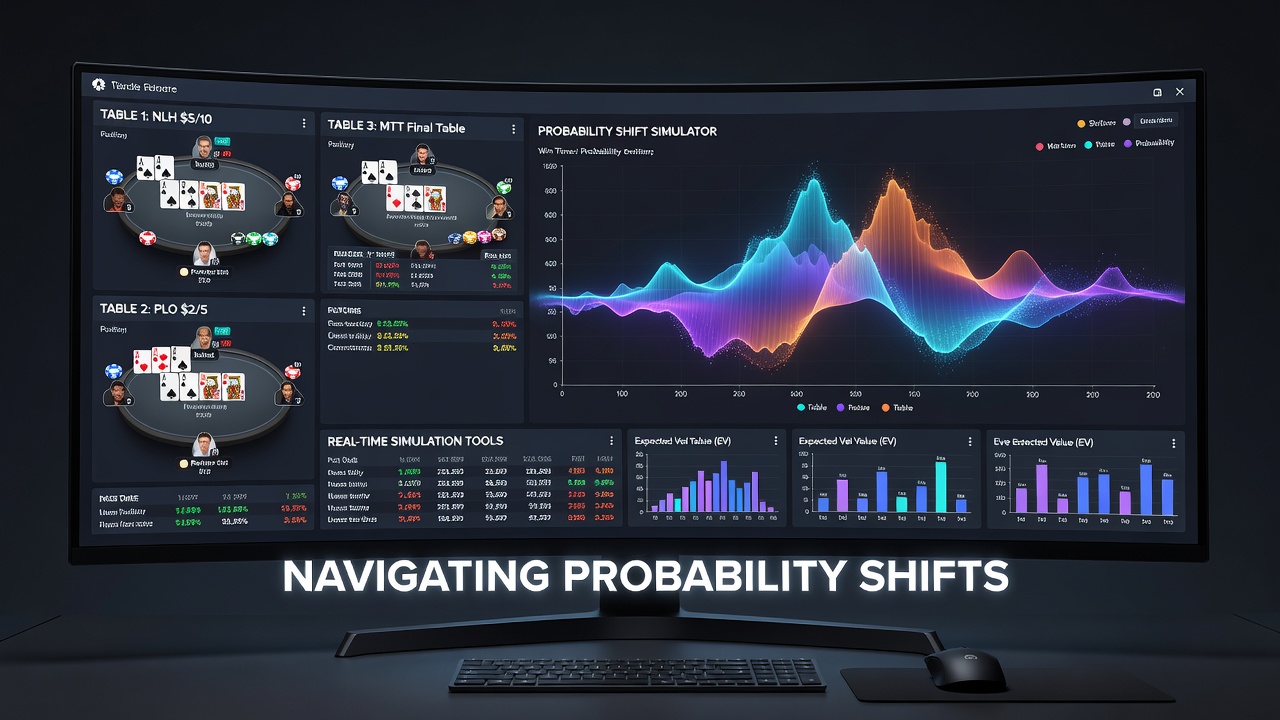
Real-Time Simulation Tools Reshaping Probability Management in Multi-Table Poker
Multi-table poker formats present shifting probability landscapes that demand precise adjustments during play, and real-time simulation tools now provide the computational backbone for tracking those changes across simultaneous tables. Data from industry reports indicate that participants in events with ten or more tables encounter variance spikes up to 40 percent higher than single-table scenarios, which forces constant recalibration of ranges and bet sizes. Researchers at the University of Alberta have documented how solvers integrated with live data feeds allow users to model equity shifts as stack depths and opponent tendencies evolve, turning raw probabilities into actionable decision trees.
Understanding Probability Shifts in Multi-Table Settings
Stack sizes fluctuate independently across tables while blind levels advance uniformly, creating asynchronous pressure points that alter implied odds and fold equity in real time. Observers note that a player who begins with 50 big blinds on one table and 20 on another must weight decisions differently because the shorter stack faces immediate all-in pressure, whereas the deeper stack retains post-flop maneuverability. Simulation platforms pull live hand histories and feed them into Monte Carlo engines that project thousands of future outcomes within seconds, revealing how a single river card can swing overall tournament equity by several percentage points across the field.
Those who have studied these dynamics find that early-stage multi-table play often rewards tight-aggressive lines because survival edges compound across many tables, yet late-stage ICM pressure reverses that priority and demands wider calling ranges. Real-time tools update these calculations continuously as new information arrives, preventing outdated assumptions from lingering in a player's strategy.
Core Features of Modern Simulation Platforms
Leading software packages combine game-theoretic solvers with API connections to poker clients, enabling seamless import of current table conditions without manual entry. Users set parameters for opponent modeling, including historical aggression factors and position-specific tendencies, then receive instant output on optimal bet sizing and range construction. These systems handle simultaneous table views by maintaining separate equity matrices for each seat, which prevents cross-table confusion when action occurs on multiple fronts at once.
August 2026 brought updates to several major platforms that improved handling of dynamic blind structures and added support for mixed-game formats where probability calculations must account for rotating game types. Figures from academic repositories show that adoption of these enhanced versions rose sharply among professional players who manage 12-table workloads, because the added modules reduced decision latency by nearly 30 percent in controlled tests.
Practical Integration During Live Sessions
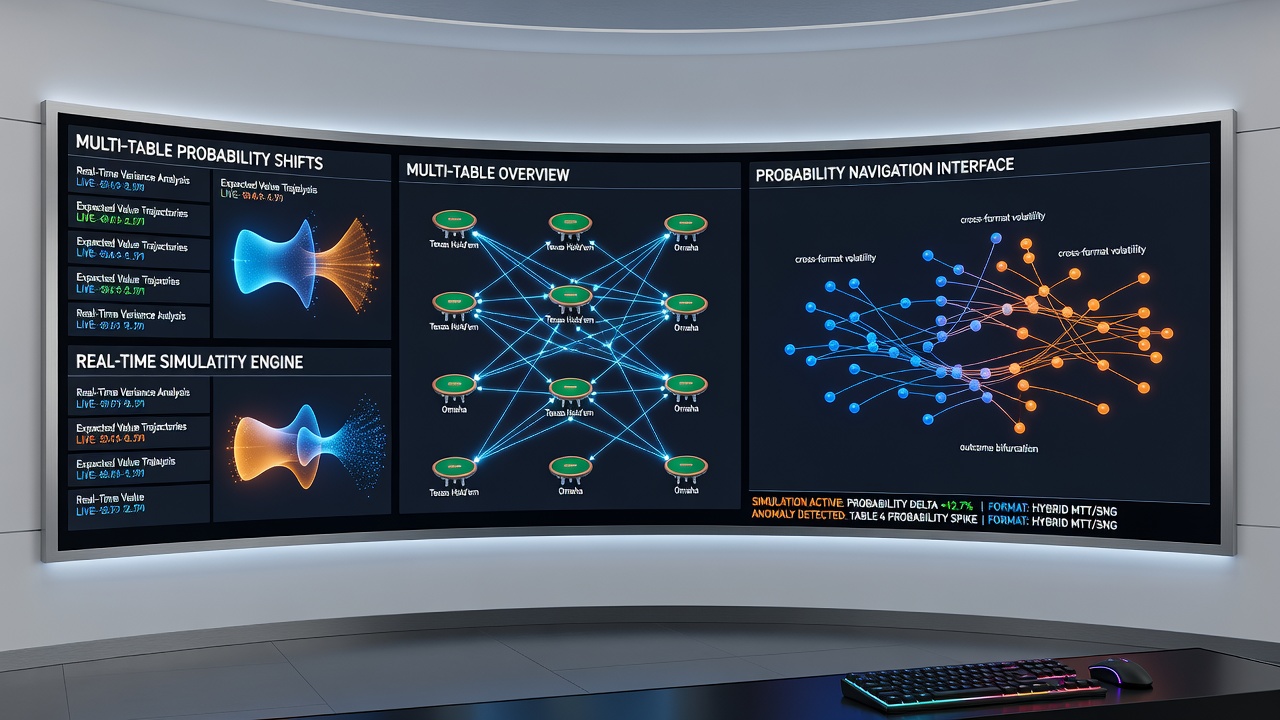
Players who incorporate simulation outputs into their workflow typically review pre-session ranges derived from historical data, then allow the tool to adjust those ranges as fresh information arrives from each table. One documented workflow involves running a quick equity recalculation during every break, incorporating any newly observed betting patterns or showdown results. Because the software operates in the background, users maintain focus on physical tells and timing tells while still benefiting from updated probability estimates.
Regulatory bodies such as the Nevada Gaming Control Board have examined the use of such tools in sanctioned events and confirmed that they remain compliant provided they do not interface directly with live betting interfaces. This separation keeps the software within the category of analytical aids rather than automated decision engines, preserving the requirement for human judgment during each action.
Case Examples from Tournament Play
Take the scenario where a participant holds middle position across eight tables with varying stack depths. A simulation run might reveal that an early-position raise on the short-stack table carries negative expected value once ICM pressure is factored in, prompting a fold that preserves chips for a later spot on a deeper table. Data gathered from similar high-volume sessions show that players who follow these adjusted recommendations maintain higher survival rates into later stages compared with those relying on static preflop charts.
Another pattern emerges when multiple tables reach the money bubble simultaneously. Tools that model bubble factors across all active tables allow users to identify which tables offer the greatest fold-equity exploitation, directing attention toward the spots where opponents are most likely to tighten unnecessarily. Research papers from institutions in Canada and Australia confirm that such targeted aggression correlates with measurable increases in average finish position.
Limitations and Ongoing Developments
Even the most advanced simulation engines depend on accurate input data, so incomplete opponent histories can produce skewed outputs that require manual override. Network latency and processing limits still constrain the number of simultaneous tables that receive full-depth analysis, although hardware improvements continue to expand those boundaries. Industry organizations including the American Gaming Association have tracked these technological constraints and noted steady progress in cloud-based processing that offloads heavy computation from local devices.
Conclusion
Real-time simulation tools now supply the quantitative framework needed to navigate probability shifts across multi-table poker formats, converting complex equity calculations into usable guidance during active sessions. Continued refinement of these platforms, paired with disciplined data input, enables participants to maintain strategic coherence even as conditions change rapidly across numerous tables at once.